
- Yogasana Live
- How to notice progress in beginner pranayama
A guided practice
How to notice progress in beginner pranayama
Follow a guided practice for observing comfort, breathing transitions and familiarity with cues. Finish with a short practice note that records what you notice and the adjustments you make.
- First shared
- Stages
- Go to the list of 6 stages
This version went live once the site's automated checks on its content and sources had passed, on Monday, 9 November 2026. Before you practise
Stage 1 of 6
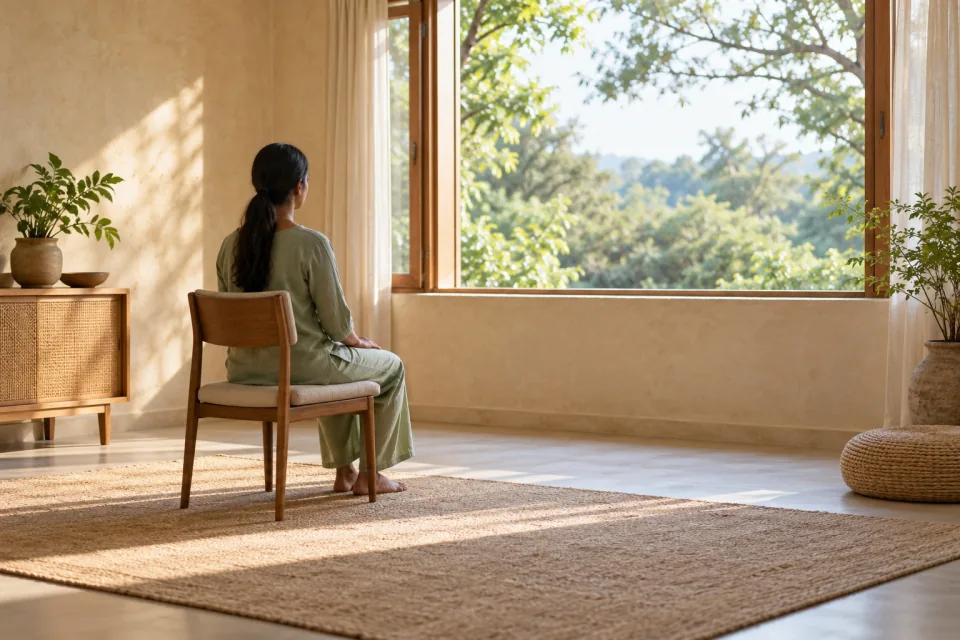
Settle into a supported position
Begin your pranayama practice by noticing comfort in your chosen position. Use this observation as the starting point for reflecting on your practice, alongside breathing quality and familiarity with the instructions.
Choose a seated or reclining position. Use a chair, a wall or cushions for support, and take time to arrange the position before directing your attention towards breathing.
If you sit upright, bring your head, neck and trunk into vertical alignment. Release any effort that you do not need to maintain the position, while allowing your breathing to continue naturally.
If you recline, begin by noticing how breathing feels in that position. Leave the rhythm alone while you become familiar with the contact between your body and its support.
Check whether your chosen position feels comfortable for observing the breath. Keep the question specific to the position you are using now, without deciding how the rest of the practice should feel.
Make an adjustment if you want a different arrangement of support. Then direct your attention back towards breathing and notice its sensations in the adjusted position.
Compare the sensations before and after that adjustment. Attend to what you can observe, such as where movement is clearest, rather than assigning the whole position a label of good or bad.
Keep the support in place as you continue. For this reflection, record the position you use without making removal of support a goal or a test of progress.
Pause the exercise and rest. Return to normal breathing.
Remember the arrangement you settle into. At the end of the practice, describe the support and position plainly so that your later notes have a clear starting point for comparison.
Stage 2 of 6
Feel the breath without changing it
Observe your natural breathing before deliberately changing its rhythm. Follow the breath as it is, including differences between breathing in and breathing out.
Notice the pace of the inhalation. Let it finish without asking it to become longer, and then observe the pace of the exhalation with the same attention.
Attend to the character of the movement. Notice whether the flow seems consistent throughout the inhalation or whether its beginning, middle and ending feel different.
Bring the same curiosity to breathing out. Follow the movement through its course, allowing the exhalation to remain as it is while you learn to recognise its details.
Rest a hand lightly on your abdomen if you want a tactile cue. Observe the movement beneath your hand as you breathe in and breathe out, without pressing to create a particular movement.
Use the hand as a place to direct your attention. Follow what you feel beneath it rather than trying to make the movement larger or more visible.
If you are reclining, explore the movement around your abdomen. If you are sitting upright, also notice movement around the sides of your ribs, leaving room for the positions to feel different.
Compare the location of the movement when you change position. Keep the comparison descriptive, such as noticing the abdomen more clearly while reclining or the ribs more clearly while sitting, if that matches your observation.
Bring your attention back to comfort after exploring movement. Let the breath find a pace that feels natural to you in the position you are using.
Notice how much deliberate effort you are adding. Release that effort while continuing to observe the breathing sensations, rather than repeatedly arranging the breath to match an imagined version of the exercise.
Choose a detail from this stage to remember. Keep it close to the experience, such as the location of movement or a difference between inhalation and exhalation, without turning it into a verdict about your ability.
Stage 3 of 6
Follow the breath through its transitions
Follow the breath through the change from exhalation to inhalation. Keep your attention with the movement as breathing out ends and breathing in begins.
Begin by observing the exhalation already taking place. Let your attention travel with it towards its ending, without deliberately extending it for the sake of this observation.
Stay with the sensation as the inhalation begins. Notice the change of direction as part of the same observation, rather than ending your attention whenever the breath changes.
Follow that inhalation through its course. Observe whether the flow feels consistent from its beginning towards its ending, while leaving the amount of air out of your assessment.
Continue across the change into exhalation. Allow your attention to include the transition itself, as well as the more obvious movement of breathing in or breathing out.
Distinguish the flow within a breath from the change between breaths. You can attend to the course of an inhalation and then explore how its ending leads into the exhalation.
If an even-breath instruction is familiar to you, attend to consistency within each inhalation and each exhalation. Keep your attention on the quality of the flow rather than making the breath larger.
Return to simple observation whenever you want to release deliberate shaping. Let breathing continue at a personally comfortable pace while you follow its movement.
Use the same transition as a reflection prompt in later practice. Compare what you notice about the ending and beginning, without assigning a required duration to either part.
Separate noticing a transition from changing it. If you become aware of a detail you previously passed over, record that detail as an observation rather than immediately trying to correct it.
Finish this stage by following breathing without a running explanation. Let the sensations carry your attention across the changes, and leave the description for your practice note afterwards.
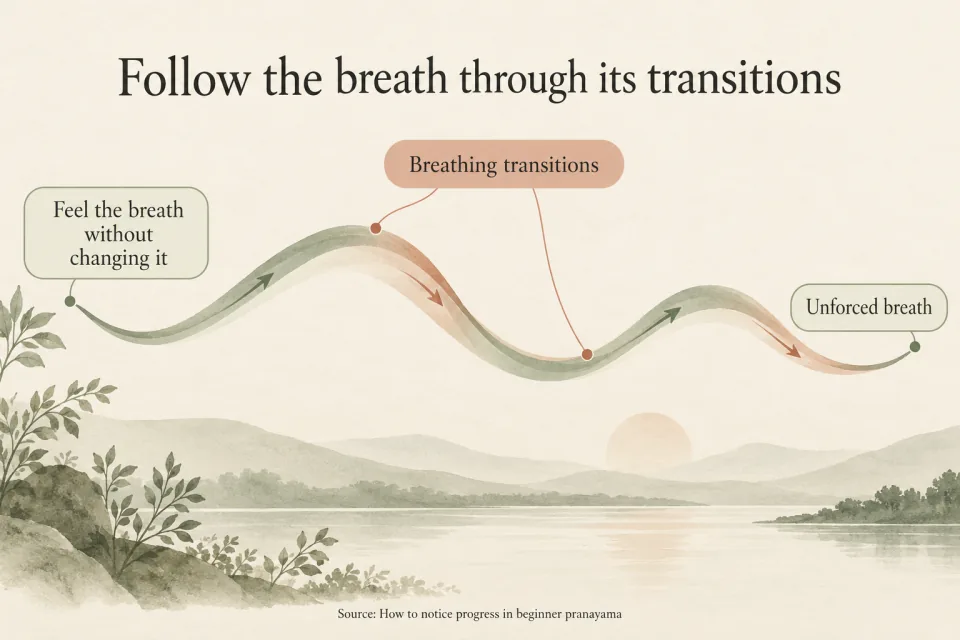
Follow the breath through its transitions. Image: Yogasana Live Stage 4 of 6
Listen with an unforced breath
Listen according to the breathing practice you are doing. During quiet breath awareness, continue observing natural breathing without adding a deliberate sound.
Let listening sit alongside the sensations you have already explored. Attend to what is present while keeping the same comfortable pace, rather than changing the exercise to produce something more noticeable.
If you already practise ujjayi, bring your listening to that familiar practice while seated comfortably. Attend to its deliberate sound as a separate exercise from quiet observation of natural breathing.
Listen through the course of the inhalation. Keep the sound unhurried and unforced, and notice its quality from the beginning of the breath towards the end.
Attend to changes within the sound. Notice any wavering or changes in pitch without trying to make the breath louder to hear it more clearly.
Listen for an even quality as the breath continues. Keep the instruction about sound connected to the flow of breathing, rather than assessing the sound apart from the breath that accompanies it.
Release extra effort as you listen. Return your attention to the relaxed quality of the practice instead of repeatedly adjusting the sound to meet an imagined standard.
If ujjayi is unfamiliar, continue with natural breathing and the sensation of movement. Use the quiet awareness exercise for this reflection, leaving the sound exercise for instruction in that technique.
Keep your comparison within the practice you choose. Compare quiet awareness with your observations of quiet awareness, and compare ujjayi sound with your observations from that exercise.
Describe the listening cue precisely in your later note. If you practise ujjayi, record what you notice about evenness or effort; if you observe natural breathing, record the sensations that hold your attention.
Carry that distinction into your next practice. Begin with the cue that belongs to the exercise you are doing, and listen without asking every breathing method to sound alike.
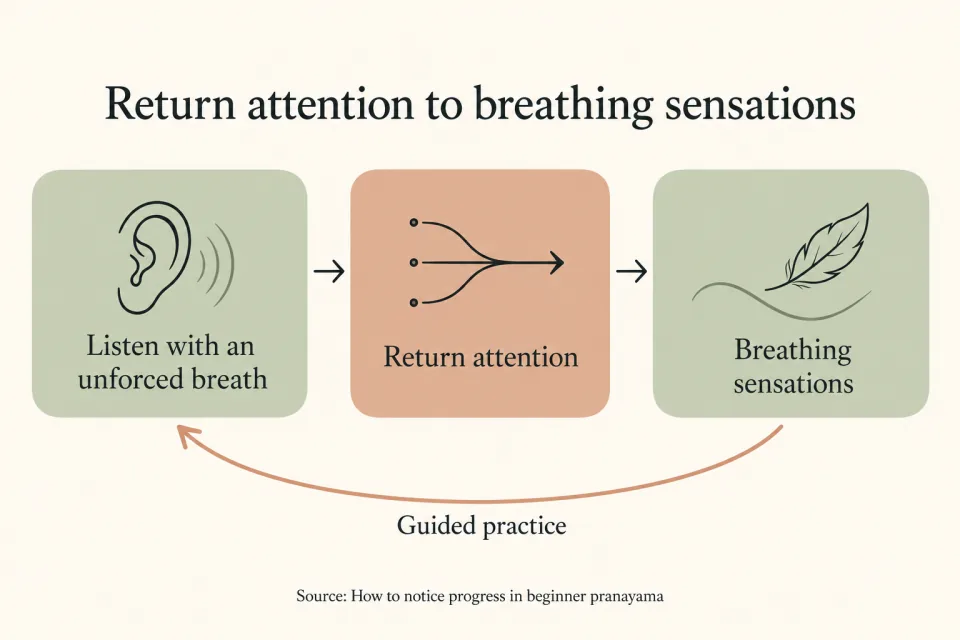
Return attention to breathing sensations during guided practice. Image: Yogasana Live Stage 5 of 6
Return attention to breathing sensations
Rest your attention on the sensation of breathing at the nostrils. Follow the sensation through the breath and across the transition into the next breath.
Let thoughts be present while you observe. Continue with the breathing exercise without requiring a silent mind before you begin or before you consider the practice complete.
When you notice that your attention has wandered, bring it patiently back to breathing. Resume with the sensation available now, without reconstructing every breath you did not follow.
Attend to the sensation itself instead of describing each movement in words. Leave any account of the practice until afterwards, when you can choose the details you want to remember.
If the nostril cue is unclear, return to the breathing movement you can feel. Follow that movement, then explore the sensation at the nostrils again when you want to shift attention.
If counting successive breaths is already part of your attention exercise, use it temporarily. Then leave the count and return to the movement or sensation you are observing.
Keep the return to breathing gentle. Release the demand to hold attention perfectly, and pick up the exercise from wherever you notice yourself becoming distracted.
Notice your familiarity with the instruction as you return. Reflect on whether you recognise what the cue asks you to observe, without turning familiarity into a requirement to remain attentive throughout the practice.
For example, when the cue directs you to breathing movement, notice whether you know where to place your attention. When it directs you to the nostrils, explore that sensation rather than continuing to search for abdominal movement.
If you already practise alternate-nostril breathing, reflect separately on its inhale-switch-exhale instruction. Notice whether the sequence feels familiar while keeping the breathing gentle and slow.
Keep that observation about coordination separate from your observation about comfort. In your note, describe remembering the sequence and the quality of breathing in their own terms, without assuming that either tells the whole story.
Return to the simplest cue you are using today. Stay with the available sensation, and let the practice end without testing how many instructions you can remember.
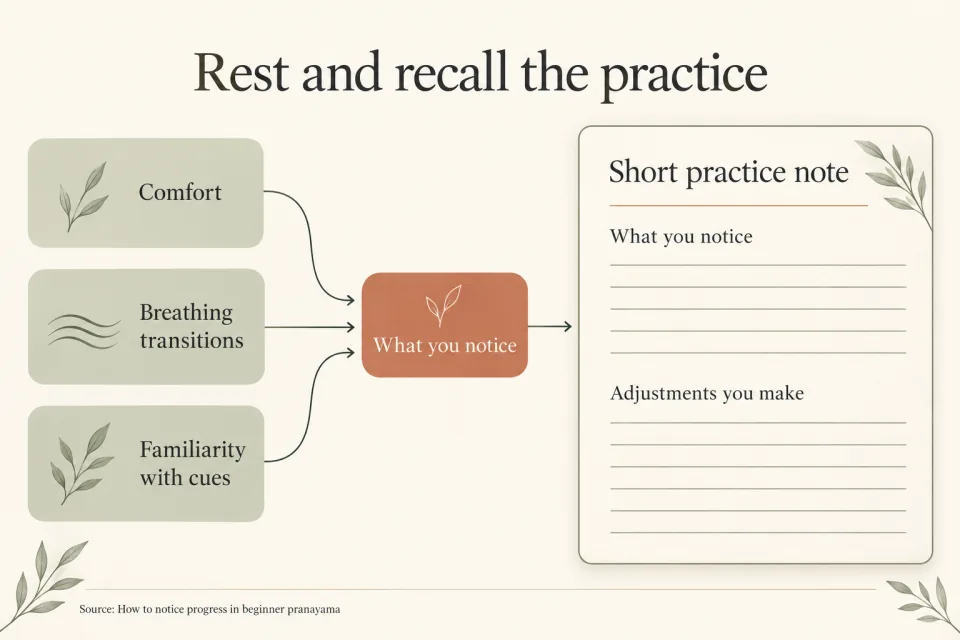
Record what you notice and the adjustments you make. Image: Yogasana Live Stage 6 of 6
Rest and recall the practice
Pause after pranayama and notice how your body feels before beginning another practice. Let breathing continue naturally while you bring the guided exercise to a close.
Recall the position you used. Name the chair, wall, cushions or reclining arrangement in your note, along with any change you made during the practice.
Record a breathing sensation that became clearer to you. Describe its location or character, such as movement beneath your hand, movement around the ribs or the sensation at the nostrils, only if you noticed it.
Choose a cue to describe in more detail. Record what you did in response to it, keeping the note about your own observation rather than writing a general statement about what pranayama does.
For a comfort observation, describe the position and the adjustment together. If you changed your support, record how breathing felt before and after the change without assuming in advance that the adjustment helped.
For a transition observation, describe the change from breathing out to breathing in. Include what held your attention at that point, without attaching a count or duration that the exercise did not give you.
For an effort observation, recall where you were deliberately shaping the breath. Record the instruction you returned to, such as allowing a natural pace or observing sensations while releasing deliberate effort.
For a familiarity observation, name the cue you recognised. If you remembered where to direct your attention, describe that moment without calling it proof that you are ready for a more complex practice.
Build a short note from these details in a consistent order. Begin with position, move to the cue you explored, and finish with the adjustment you made and what you observed afterwards.
Use a seated practice as a worked example of that order. Record the support used, the breathing sensation you followed and any change of position, then describe the sensation after that change if you noticed a difference.
Use a distracted practice as a different example. Record the sensation you returned to and whether the instruction felt familiar, leaving out an estimate of how much of the session you followed perfectly.
Read your notes across repeated practice with attention to the details they contain. Look for changes in what you recognise or can describe, while keeping comfort and breathing quality in view.
Choose a familiar observation to revisit next time. Return to it without a deadline, allowing your record of the practice to grow from what you notice as you continue.
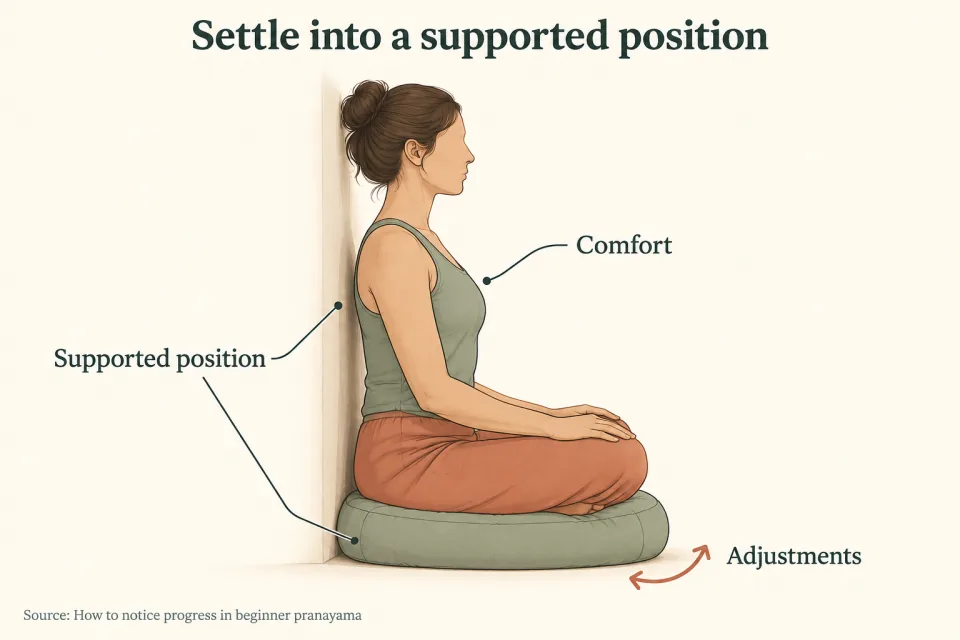
Notice support and comfort in a seated position. Image: Yogasana Live
How this practice came to be
- Written
- By Yogasana Live; no person is named as its writer
- What it rests on
- 8 sources
Sources for this practice
- Breathing Lessons
- Breath Awareness: A Guide to This Simple Yet Profound Practice
- Making Pranayama Accessible
- Free Your Breath, Free Your Mind
- What is Ujjayi?
- Step by Step: Breathing for Self-Compassion and a Focused Mind
- Enhance Your Practice: Learn the Art of Yogic Concentration
- Soothe Your Nervous System with 2-to-1 Breathing
More from the library
Follow floor yoga without watching the screen
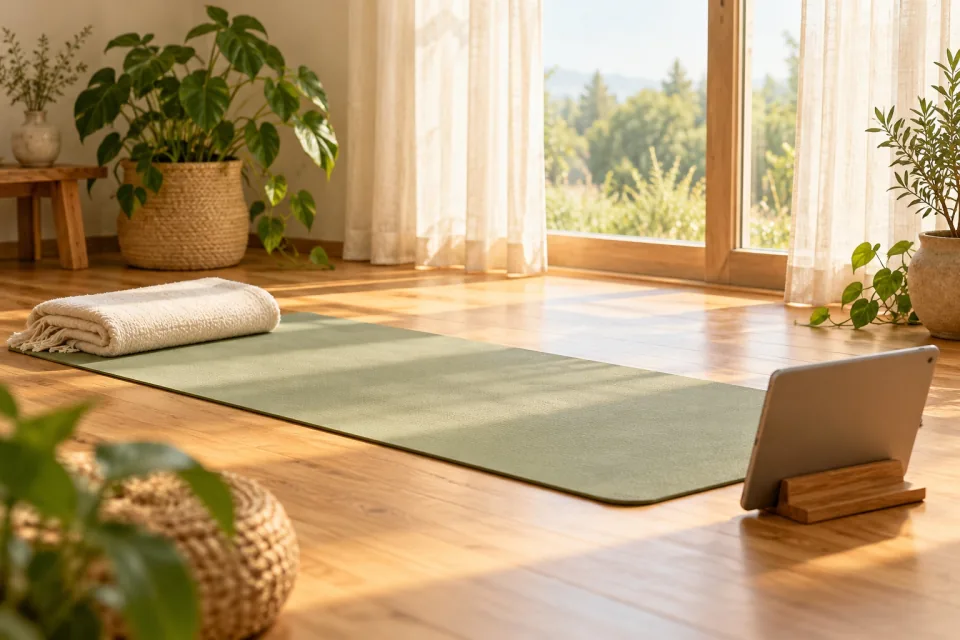
Preview entries and exits, recognise spoken position cues, and pause demonstrations before moving onto your belly or reclining. Follow a guided method for practising between viewings.
Breath counting or mantra repetition for yoga meditation
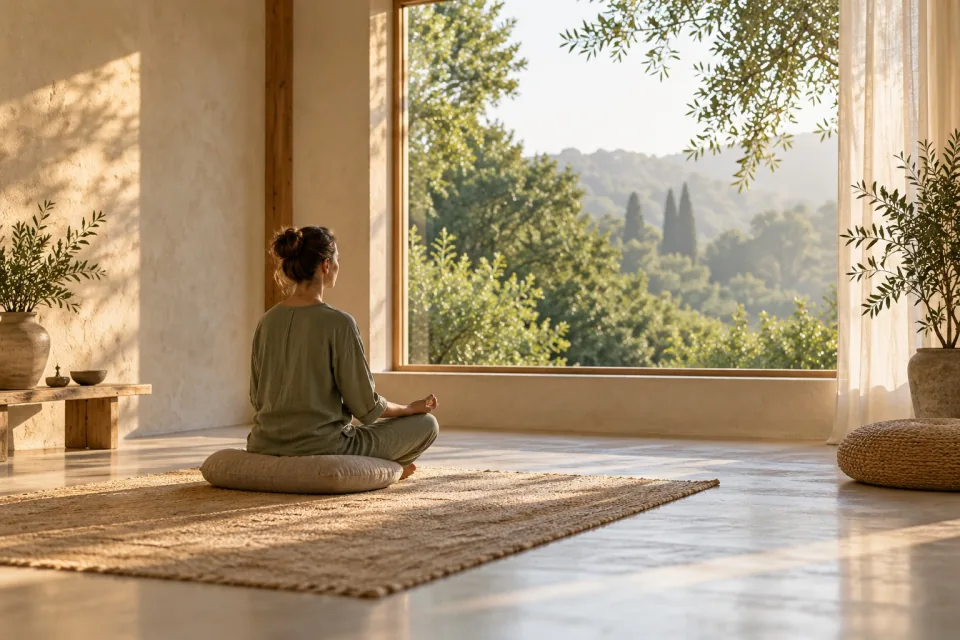
Explore breath counting and mantra repetition through a seated practice. Compare what you attend to, how repetition follows the breath and what to do when you lose your place.
Morning yoga with a shorter or longer practice
Follow the same beginner pose order for a short or longer morning practice. Give extra time to preparation, repeated standing movements and a separate closing pause, with adjustments beside each pose.