
- Yogasana Live
- Breath counting or mantra repetition for yoga meditation
A guided practice
Breath counting or mantra repetition for yoga meditation
Explore breath counting and mantra repetition through a seated practice. Compare what you attend to, how repetition follows the breath and what to do when you lose your place.
- First shared
- Stages
- Go to the list of 5 stages
This version went live once the site's automated checks on its content and sources had passed, on Friday, 27 November 2026. Before you practise
Stage 1 of 5
Sit and notice your breathing
Sit on a chair with your feet touching the floor. Rest your hands on your knees or in your lap, leaving them there as you begin.
Settle into a stable seat. Notice where your body meets the chair and where your feet meet the ground, without immediately turning your attention toward a count or a phrase.
Let your back be upright and relaxed. Allow your shoulders and neck to relax, keeping the seated position simple enough that you can begin observing your breathing.
Choose an open gaze, closed eyes or a softly lowered gaze. Use that choice while you settle, rather than treating closed eyes as a requirement for the practice.
Find the movement of your breathing. You might notice your belly rising and falling, or feel the breath around your nostrils, chest or throat.
Stay with a place where the sensation is apparent. The breathing practice allows attention to rest at a location without searching for sensations everywhere the breath can be noticed.
Observe your breathing without deliberately changing its speed or depth. Follow the breath that is already happening, including the movement as it comes in and goes out.
Let the belly's movement be your point of attention if that feels clear. Follow its rise as you breathe in and its fall as you breathe out, without adding a number yet.
Use ordinary breath awareness for this opening. Sitting with attention on breathing does not require choosing a particular pranayama technique, so you can begin with the breathing you notice in your seat.
Choose what you will follow during the next part of the practice. Breath counting gives you a changing number attached to successive breaths; mantra repetition gives you a word or phrase to repeat.
Keep the same seated setup when exploring either approach. This practice brings their instructions together so you can compare the act of counting with the act of returning to familiar words.
Begin with breath counting if you want to follow these stages from start to finish. If you want to explore a mantra on its own, carry this seated setup into the stage for choosing a word or phrase.
Stage 2 of 5
Count as you breathe out
Place a silent number on each exhalation, counting from one to ten. Let the number accompany the outgoing breath while your attention remains on the breathing sensation you chose.
Allow the inhalation to happen without adding another count. In this version, the count advances with the exhalation, so an incoming breath does not move you forward in the sequence.
Keep the number connected to the breath you are feeling. You are following successive breaths, rather than using a string of numbers to measure how long an inhalation or exhalation lasts.
Avoid changing the breath's depth or speed to fit the count. Let the number follow the breathing, keeping the natural pace you noticed while settling into your seat.
After reaching ten, return to one on the next exhalation. Continue with the same counting pattern, without extending the sequence simply because you still remember your place.
If you lose your place, restart at one. Resume with an outgoing breath rather than trying to reconstruct the part of the sequence that passed while your attention was elsewhere.
Notice a distraction without trying to suppress it. Bring attention back to breathing and resume the counting practice, leaving the distraction without needing to finish following it.
Distinguish this method from counting a complete breathing cycle downward. The methods use different points for changing the number, so choose a convention before trying to follow it.
For the alternative countdown, start at twenty and work toward zero. Let the same number accompany the inhalation and the exhalation before decreasing it for the next complete breath.
Keep that number through the incoming and outgoing movement. In this countdown, changing the number halfway through the cycle would mix the instructions with the exhalation method above.
Return to the starting number if you lose the countdown or notice your mind wandering. Begin following complete breathing cycles again, using the same convention you chose at the start.
Compare the instructions by noticing when the number changes. The upward method attaches a number to an exhalation; the downward method carries a number through an inhalation and an exhalation.
Use the chosen method for your practice without alternating between them as you breathe. You can explore the alternative separately, with its starting point and return instruction clearly in mind.
Drop the counting when you no longer need it to remain attentive to breathing. Continue to notice the same breath sensations, letting the number fall away while the observation continues.
If you choose an interval of uncounted breathing, Berkeley's guided practice gives five to seven minutes for silent observation. Follow the breath during that interval, then use the closing instructions below.
Stage 3 of 5
Choose a word or phrase
Choose a word or phrase to repeat as your mantra. A mantra is a repeated word or phrase used to direct attention toward an intention.
Start with language that means something to you if you want an intention to be part of the practice. A simple word, a sentence or a personal resolution can provide the words you return to.
Consider love as an example of a meaningful word, or Om as another choice given in the yoga textbook. Choose the word itself before deciding how to arrange its repetition.
Use a phrase in your own language if that suits your practice. You do not need to select unfamiliar words to follow the instructions for repeating a mantra.
Choose with regard to the meaning you want to engage with. Mantras can have religious or spiritual meaning, and contemporary practice also includes nonreligious words and phrases.
Keep your chosen phrase in view as the content of the practice. If it expresses a personal resolution, return to that wording rather than developing a different sentence whenever another thought appears.
Decide whether you want a practice centered on meaning or a practice centered on sound. The supplied instructions include each approach, so the emphasis depends on the exercise you choose.
For a sound-centered example, the University of Connecticut's I AM exercise directs attention to the phrase's sound rather than its meaning. Repeat the words internally as the exercise describes, without turning the repetition into an examination of what the sentence means.
If you choose a meaningful word instead, keep the intention associated with that choice. You can distinguish selecting meaningful language from the separate instruction to attend mainly to an internal sound.
Choose silent repetition if you want to explore the mantra while sitting quietly. Repetition can also be spoken aloud, so silence is a way to practice rather than part of the definition of a mantra.
Use the term mantra repetition for the action you are about to try. The yoga textbook also calls this practice japa meditation.
Settle on the wording before beginning the repetition. This gives the next stage a clear action: return to the selected word or phrase whenever you notice that attention has moved away from it.
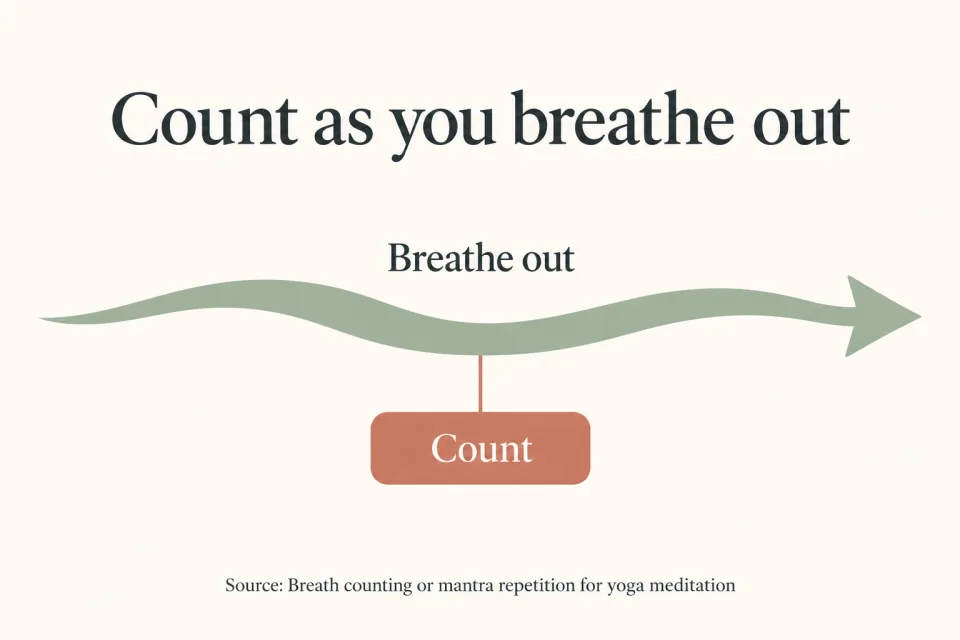
Counting accompanies breathing out. Image: Yogasana Live Stage 4 of 5
Repeat the words with your breath
Begin repeating your chosen mantra silently. Let the words be the focus you return to while remaining in the seated position you have already established.
Use a quiet place for this part of the practice. Silence your phone as part of the preparation, then turn attention toward the phrase rather than continuing to arrange the setting.
Choose a timed session if you prefer an ending that does not require tracking repetitions. North Carolina State University suggests that beginners may find a timed mantra session easier and can use a timer to mark its end.
For a short exploration, the University of Wisconsin–Madison handout suggests a duration as brief as five minutes. Use that duration for the mantra practice if you want a stated starting point from the instructions.
Let the phrase repeat gently in your mind. In silent practice, its internal sound provides a focus alongside the breathing you have been observing.
Try placing the whole mantra on the exhalation. Allow the inhalation to pass, then repeat the same words during the outgoing breath.
Notice how this arrangement differs from counting exhalations. The place in the breath can stay the same, but the mantra's wording repeats instead of advancing through a numerical sequence.
Choose another arrangement if you want to explore words across the breathing cycle. The Wisconsin handout also describes repeating the whole mantra during each inhalation and each exhalation.
For a longer phrase, divide its wording between the inhalation and exhalation. Carry the opening part on the incoming breath and the remaining part on the outgoing breath.
Keep the chosen arrangement clear as you repeat. Returning to a phrase on the exhalation and dividing a phrase across the breath are different instructions, so follow the arrangement you selected for this exploration.
Use the words in and out if you want the simple breath-linked example given in the handout. Silently say in while inhaling and out while exhaling, following the direction of the breath with the corresponding word.
Keep observing natural breathing as you explore that wording. Let the words accompany the movement rather than turning their repetition into an instruction to make the breath longer or deeper.
If the silent mantra becomes less distinct, do not force its mental pronunciation to become clearer or fuzzier. Continue with gentle repetition rather than trying to manufacture a particular quality of internal sound.
Return gently to the mantra when attention leaves it. Resume the familiar words instead of searching for a missing position in a sequence.
Let repeating, losing the phrase and returning be the process you follow. The return instruction is available whenever you notice the words are no longer the focus of attention.
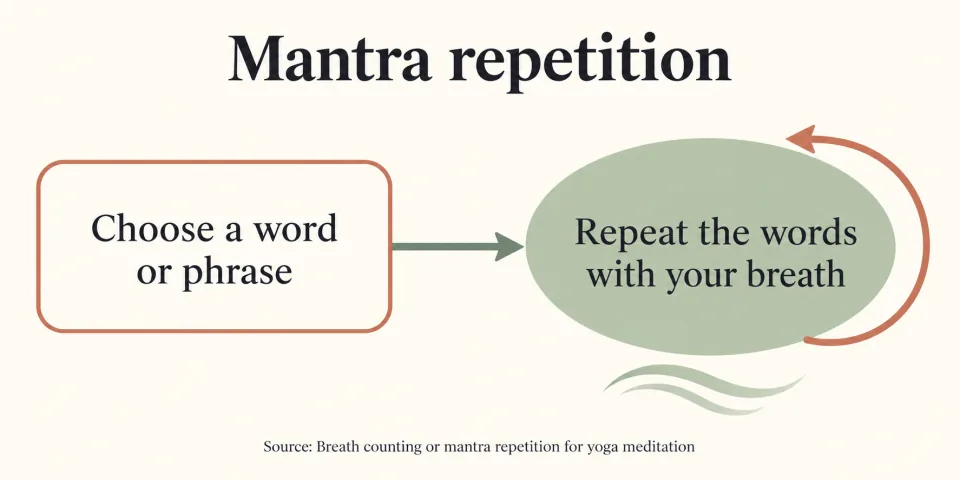
Choose words to repeat with your breath. Image: Yogasana Live Stage 5 of 5
Return to your anchor and finish
Return according to the practice you chose. A breath count has a starting point to resume from, while a mantra gives you familiar wording to repeat again.
Apply that distinction when you notice you have been following a thought. With counting, take up the method's restart instruction; with a mantra, return to the phrase without trying to count how many repetitions you missed.
Leave the thought without trying to suppress it during breath counting. Bring attention to the physical sensation of breathing and allow the next exhalation to belong to the restarted sequence.
Try a brief mental label if you are practicing breath awareness and want a return cue. Berkeley's instructions offer thinking or wandering as labels before redirecting attention to breathing.
Let the label end when you return. The next action is to feel the breath, rather than continue describing the thought or developing an account of why you followed it.
For mantra practice, take up the same word or phrase again. Keep the return gentle, including when the repetition has become indistinct or you have been away from it for a while.
Compare the anchors through these actions. With counting, you track where you are in an ordered sequence; with mantra repetition, you recognize and resume the wording you selected.
Notice the role of breathing in the version you tried. It can be the sensation you observe and count, or the movement that carries a repeated phrase through a chosen arrangement.
Keep meaning and sound separate when recalling the mantra instructions. A word chosen for an intention and the sound-centered I AM exercise ask for different emphases, even though each involves repetition.
At the end of the practice, let attention include your whole seated body. Notice your contact with the chair or floor again, widening attention beyond the breathing sensation or repeated phrase.
Acknowledge the time you have spent practicing. Let that acknowledgment close the seated observation without adding another sequence of counts or repetitions.
Make a gentle stretch before resuming your activity if you follow the transition used in the mantra instructions. Allow the seated practice to end before moving back into what you were doing.
For another session, choose the anchor whose instructions you want to explore further. You can return to exhalation counting, try the complete-cycle countdown separately or repeat the phrase with the breathing arrangement you selected.
Choose a realistic practice duration when you return. The Wisconsin handout emphasizes regular practice over occasional long sessions, so let a manageable session be a complete practice.
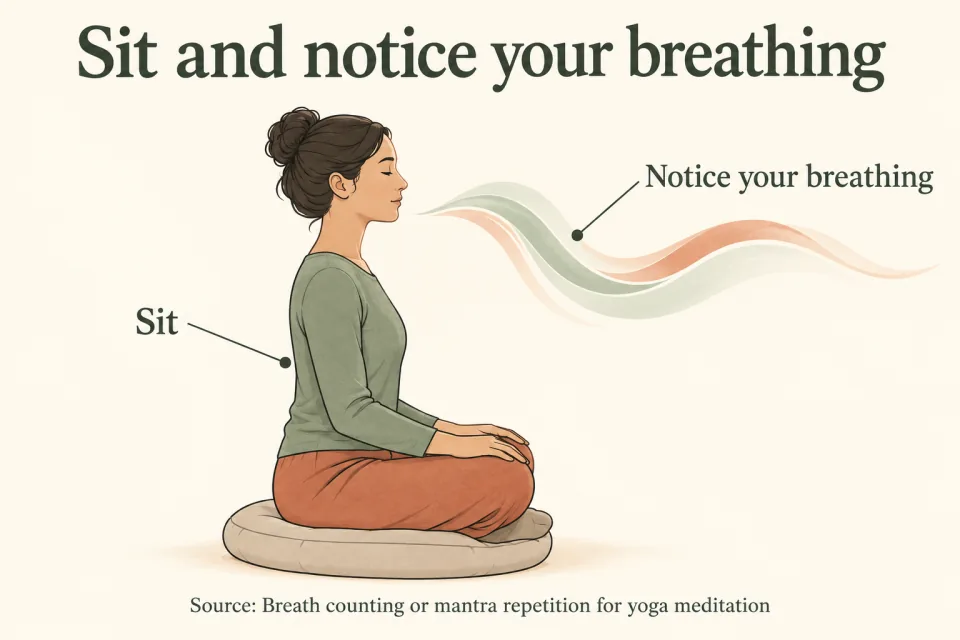
Sit and notice your breathing. Image: Yogasana Live 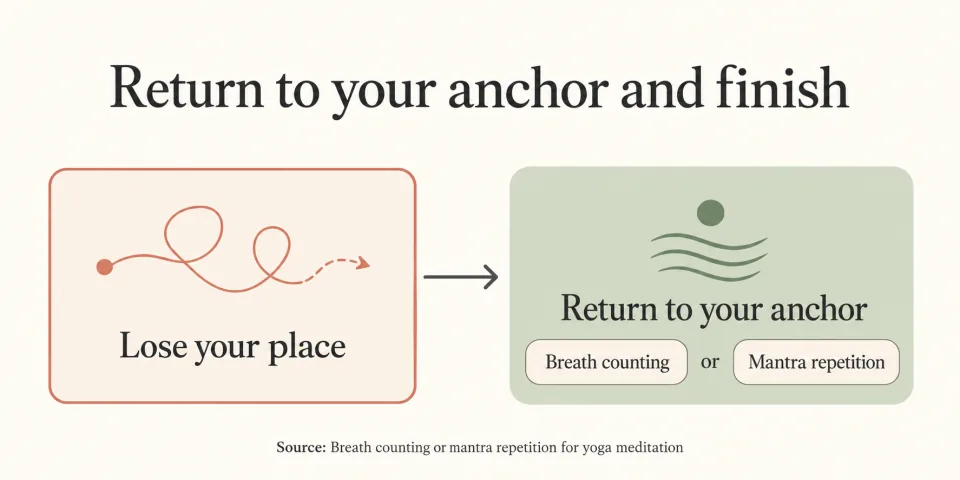
Return to your anchor when you lose your place. Image: Yogasana Live
Sources for this practice
How this practice came to be
- Written
- By Yogasana Live; no person is named as its writer
- What it rests on
- 6 sources
More from the library
How to warm up before sun salutations

Follow a guided preparation sequence for reaching overhead, folding at the hips and supporting yourself through your hands, then move into the opening of your sun salutation.
Yoga meditation for a noisy home

Follow a seated meditation practice with ordinary household sounds present. Explore breath, sound and touch as attention anchors, then practise returning after wandering thoughts or an interruption.
Head-to-knee pose: align your torso before folding
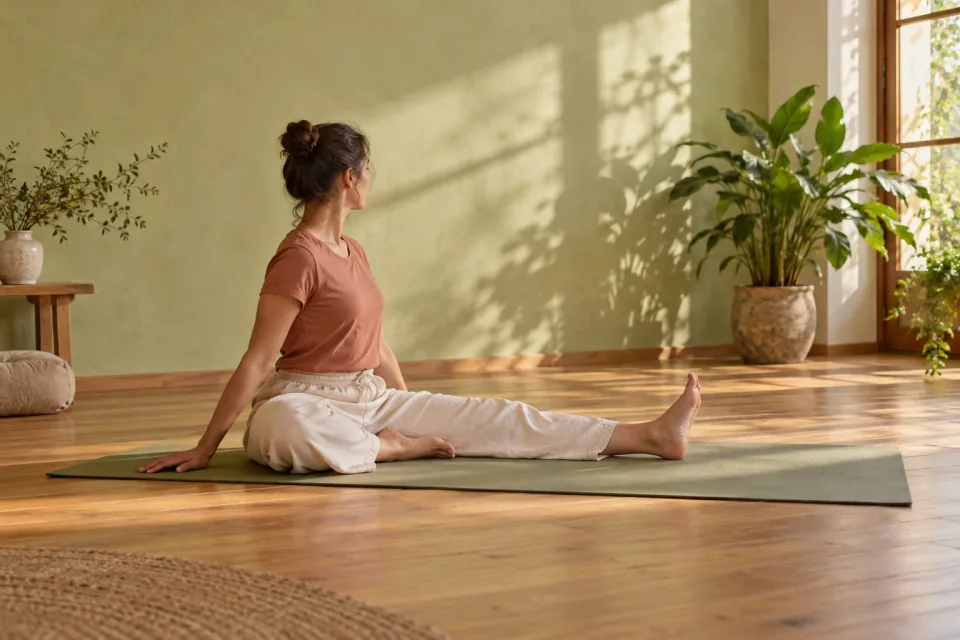
Follow a seated practice that guides your abdomen and ribs toward the extended leg. Choose a reachable hand position, fold from the hips and practise lifting out to reset your alignment.