
- Yogasana Live
- How meditation fits within yoga's limbs
A guided practice
How meditation fits within yoga's limbs
Follow a seated practice that connects posture, breathing and attention with yoga's traditional framework, including the distinction between returning your focus and sustained meditation.
- First shared
- Stages
- Go to the list of 6 stages
This version went live once the site's automated checks on its content and sources had passed, on Monday, 16 November 2026. Before you practise
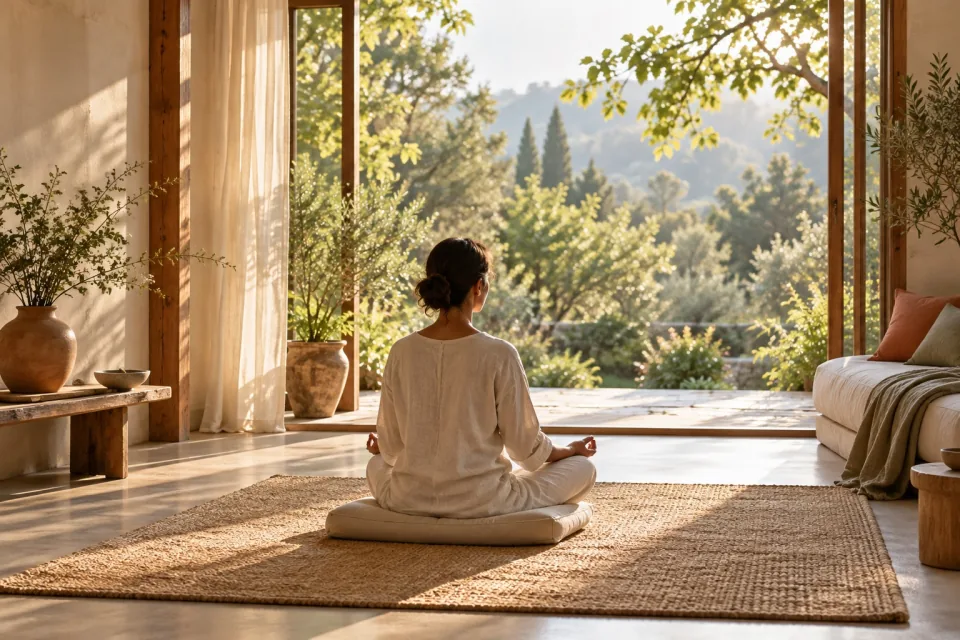
Stage 1 of 6
Bring the whole practice into view
Begin with meditation's place in the whole practice: dhyana is meditation within Patanjali's eight limbs of yoga. Keep that relationship in view as you approach the seated exercise.
Read the traditional order before using it to understand your practice. Yoga Sutra 2.29 names yama, niyama, asana, pranayama, pratyahara, dharana, dhyana and samadhi in that sequence.
Hold the image of connected limbs as you read. Old School Yoga explains anga as a limb or a member of the body.
Use the sequence without making each term a task that you must finish. Anand Paranjpe describes the eight limbs as an interdependent whole, with ethical practice continuing throughout life.
Bring conduct into the picture alongside sitting. North Carolina State University's textbook describes yama as ethical guidance for conduct toward others and niyama as guidance for internal thoughts and actions.
Keep the meanings of the ethical terms specific. In the university's account, ahimsa concerns nonviolence or non-harming, while satya concerns truthfulness.
Read asteya as non-stealing and aparigraha as non-hoarding or non-possessiveness. These are further examples of the conduct addressed within the framework.
Turn to the observances with the same care. The university gives cleanliness or purity for saucha and contentment for santosha.
Consider study and discipline alongside those observances. The university describes tapas as discipline and svadhyaya as study of the nature of the self.
Keep these meanings connected to the meditation exercise without trying to perform them all during a sitting. Paranjpe's account treats yama and niyama as continuing ethical practices, rather than preliminary tasks completed before other limbs begin.
Approach the stages below as ways to examine different parts of a seated practice. Use the traditional order to understand their relationships, while allowing attention to return to posture or breathing whenever the exercise calls for it.
Leave the full framework in view as you take your seat. Your immediate task is to explore sitting and attention within it, without turning the names into a record of completed achievements.
Stage 2 of 6
Settle into your seat
Sit comfortably with your spine tall, following North Carolina State University's seated breath practice. Begin by attending to how you sit, before choosing what you will attend to while sitting.
Use posture as the subject of this stage. Asana can mean a seat, sitting down or a particular way of sitting, according to Old School Yoga's commentary.
Keep the description of the seat simple. In its account of Yoga Sutra 2.46, Old School Yoga identifies comfort and steadiness as the defining qualities of asana.
Attend to comfort as you settle. Let the word guide your choice of sitting position rather than using the appearance of a pose as your reference.
Attend to steadiness next. Stay with the position you have chosen while you consider whether it allows you to continue the seated exercise comfortably.
Keep the spine tall without turning that cue into a demand for a particular pose. Paranjpe explains that Patanjali gives qualities for posture without specifying named poses.
Read those qualities as the relevant instructions for this practice. You can work with the description of sitting before adding a pose name or trying to reproduce an elaborate shape.
Notice how much effort you bring to maintaining the seat. Old School Yoga's commentary on Yoga Sutra 2.47 connects posture with relaxation of effort and the infinite.
Keep that reference to the infinite within the commentary's philosophical setting. For the practical cue here, attend to the effort involved in sitting and allow the seat to remain comfortable.
Place posture in relation to the meditation that follows. North Carolina State University's textbook presents asana and pranayama as preparation for meditation.
Move from considering the seat to experiencing the breath while you remain seated. This gives posture a concrete place in the exercise: you sit, then attend to breathing from that position.
Return to the qualities of the seat if you need to reconsider how you are sitting. Treat that return as part of the same practice, consistent with the interdependent account of the limbs.
Let the question of an impressive posture fall away from this exercise. Keep your task close to the supplied instructions: a comfortable position, a tall spine and attention ready to turn toward breathing.
Stage 3 of 6
Feel the breath as it moves
Bring attention to the felt movement of breathing. Follow the inhalation and exhalation from your seated position, as in North Carolina State University's breath meditation.
Notice the incoming breath. Attend to its movement as you experience it, without adding a set rhythm to this exercise.
Notice the outgoing breath in turn. Keep the same task through the change from inhalation to exhalation: feel the movement of breathing.
Distinguish this observation from deliberate regulation. The Internet Encyclopedia of Philosophy describes pranayama as regulation of incoming and outgoing breath.
Use the distinction to identify what you are doing. In breath awareness, your task is to attend to the breath; in pranayama, regulation of breathing is part of the practice itself.
Continue with observation here. The university's breath meditation does not require you to choose a particular pranayama technique.
Try the relationship as a worked example: remain in your comfortable seat and turn attention toward the movement of breathing. Posture is the way you sit, while the breath is what you attend to in this exercise.
Keep the example specific when you connect it to the limbs. Sitting illustrates the posture element, and placing attention on breathing illustrates concentration; simply noticing the breath does not make the exercise a particular method of breath regulation.
Let the inhalation remain your object while it is occurring. As the exhalation follows, attend to that movement rather than rehearsing the names of the limbs.
Use the names when you need to understand the exercise, then return to its instructions. This separates learning the framework from the immediate task of observing breathing.
Consider counting only as an alternative form of the same exercise. The university also describes a variation in which the practitioner counts complete breath cycles downward and begins the count again after losing track.
If you choose that variation, keep the complete cycle of inhalation and exhalation connected to the count. Restart when you lose your place, as the university directs.
Choose between direct awareness of movement and the counting variation for the practice you are doing. Keep that choice distinct from adopting a breathing ratio or another form of deliberate regulation.
Finish this stage by identifying your present task in plain words: observe breathing, or observe breathing with a count. Carry that task into the attention exercise without expecting the breath alone to represent every limb.
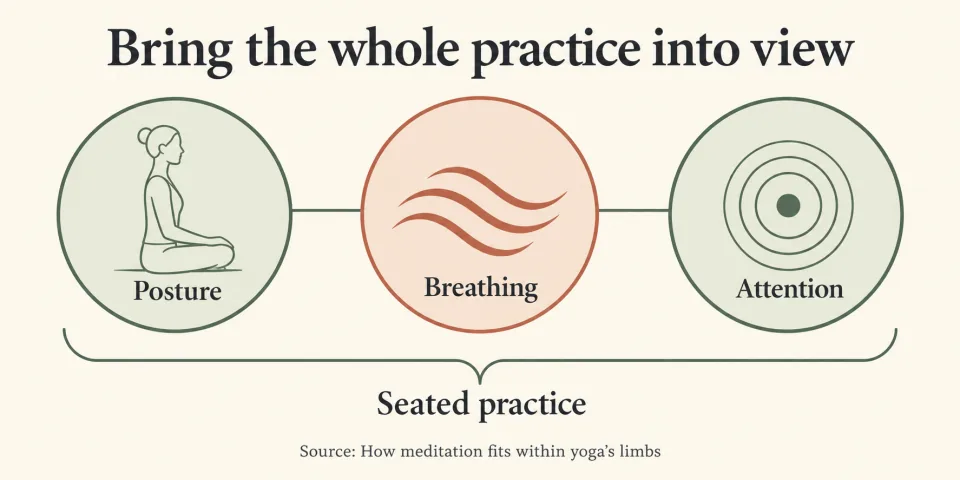
Posture, breathing and attention connect within seated practice. Image: Yogasana Live 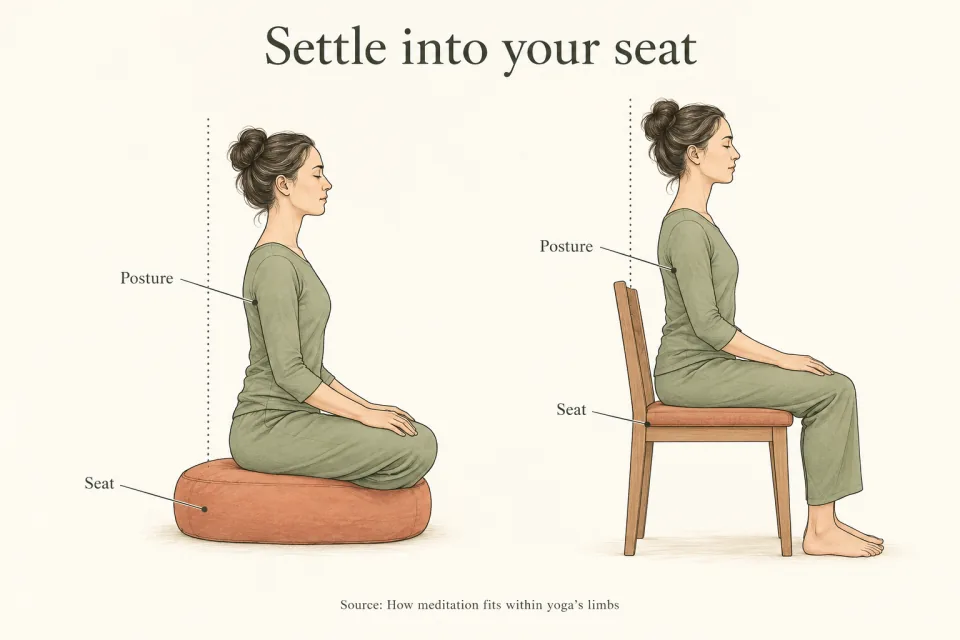
The drawings show two ways to sit for practice. Image: Yogasana Live Stage 4 of 6
Notice sounds without following their meaning
Attend to sounds as a separate listening exercise if you want to explore another object of attention. North Carolina State University's instructions ask you to notice sounds without judging or trying to define them.
Let a sound be something you hear. Follow the exercise by leaving aside the task of deciding what the sound is or whether you like it.
Keep your listening close to the instruction. You are attending to sound itself, rather than making a description of the place around you.
Notice when you begin to name a sound. Return to listening without continuing the definition, following the university's distinction between hearing and identifying.
Leave judgments aside in the same way. If you begin evaluating what you hear, take up the listening instruction again rather than developing the evaluation.
Keep this exercise distinct from the classical term pratyahara. The Internet Encyclopedia of Philosophy explains pratyahara as withdrawal from the objects of the senses.
Compare the objects of attention in the descriptions. The university's listening exercise explicitly attends to sounds, whereas the classical definition describes withdrawal from sensory objects.
Preserve that difference when you place a modern exercise beside the traditional framework. Use listening to explore the instructions given for listening, without relabeling it as a complete account of pratyahara.
Return to breath awareness if that is the exercise you choose to continue. Let the felt movement of breathing be your focus again, using the university's instruction to return after distraction.
Keep the choice of exercise clear. While listening, attend to sound without judging or defining it; while observing breathing, attend to the movement of inhalation and exhalation.
Use this comparison to understand what an object of attention means in practice. The word refers here to what you attend to, such as breathing or sound, rather than to a physical item you must hold or look at.
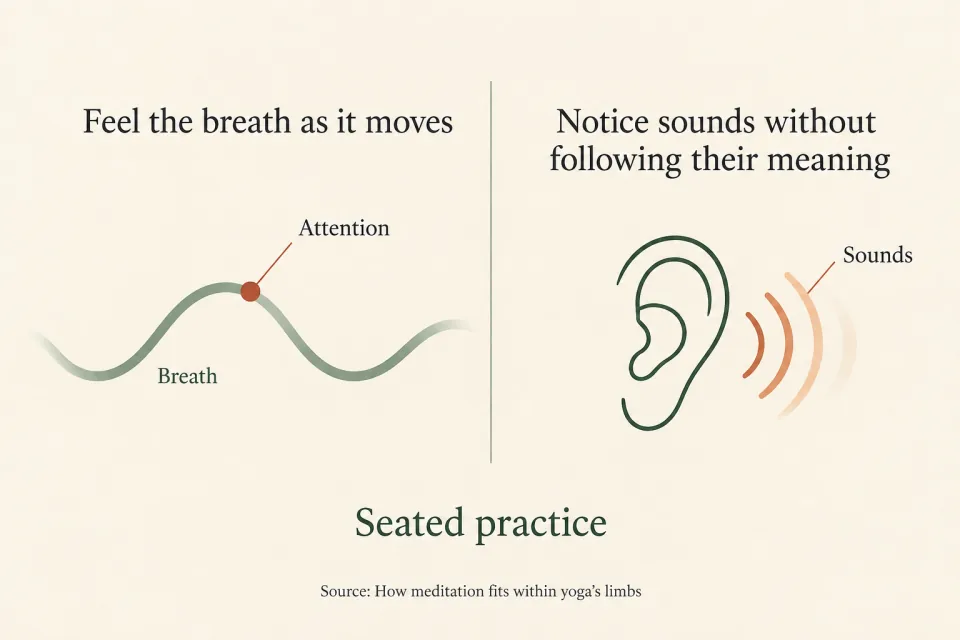
The diagram pairs noticing the breath with noticing sounds. Image: Yogasana Live Stage 5 of 6
Return attention to your chosen focus
Bring attention back to breathing when you notice it has wandered. This return is part of North Carolina State University's seated breath exercise.
Resume with the breath occurring now. Take up the felt movement of inhalation or exhalation instead of trying to reconstruct the part of the exercise you missed.
Place that action beside the classical description of concentration. The Internet Encyclopedia of Philosophy describes dharana as fixing attention on a chosen place or object.
Use breathing as the chosen object in this exercise. The instruction becomes concrete when you direct attention to its movement and return there after distraction.
Allow the act of returning to remain simple. Continue the same exercise instead of changing its object each time you notice that attention has moved elsewhere.
Choose mantra repetition as an alternative if you prefer to work with a word or phrase. North Carolina State University's mantra practice uses repetition to direct attention toward a chosen intention.
Select the word or phrase for that practice and repeat it. Keep the repetition connected with the intention you choose, following the university's description.
Repeat aloud or silently. The university includes both ways of practising, so the exercise does not depend on speaking the words where others can hear them.
Keep the choice between breath awareness and mantra clear. With breathing, attend to movement; with mantra, attend through repetition of the chosen word or phrase.
Recognize the term japa if you encounter it in the university's instructions. The page uses japa meditation for repeated mantra practice.
Choose a duration or a number of repetitions for the mantra exercise, as its instructions allow. Treat that choice as the format of your sitting, rather than as a definition of dhyana.
Return to the distinction between the exercise and the classical term whenever you evaluate what you are doing. A session can include the practical work of placing and returning attention while you are still learning what sustained meditation means in the framework.
Keep your immediate instruction unchanged as you continue. Attend to the chosen object, and use the breath exercise's return instruction whenever you resume breath awareness after distraction.
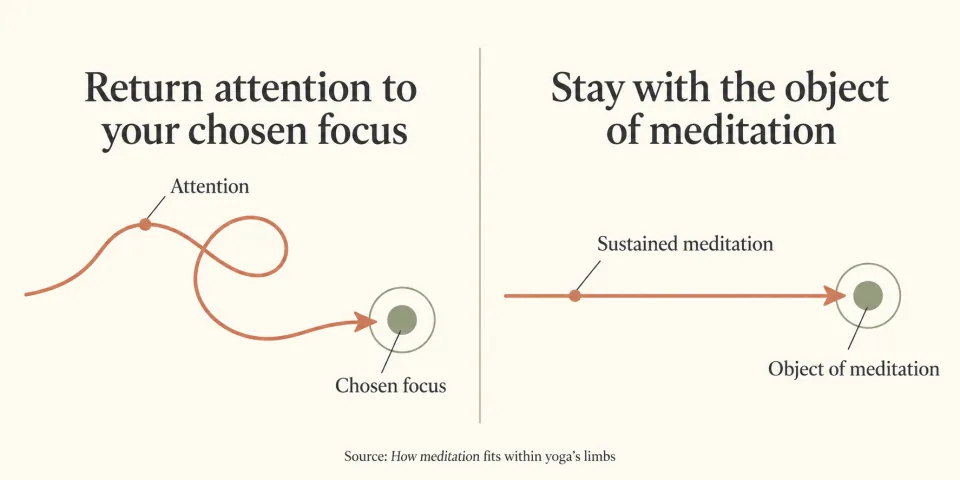
The paths illustrate returning attention and sustained meditation. Image: Yogasana Live Stage 6 of 6
Stay with the object of meditation
Stay with your chosen object while keeping dhyana's specific meaning in view. The Internet Encyclopedia of Philosophy describes dhyana as sustained attention to the meditation object without interruption from other thoughts.
Distinguish that description from the repeated return practised above. Returning to breathing is an instruction for working with distraction, while uninterrupted attention describes dhyana in the classical account.
Use the distinction without turning it into a verdict on the sitting. Follow the return instruction when needed, and reserve the term dhyana for the meaning given in the philosophical explanation.
Keep concentration and meditation connected. The Internet Encyclopedia of Philosophy presents dharana, dhyana and samadhi as successive deepenings of the same practice.
Read that relationship through the object of attention. Concentration fixes attention on the object, meditation sustains it without interruption, and the account then describes absorption.
Approach samadhi within that philosophical context. The Internet Encyclopedia of Philosophy describes absorption in the object as eclipsing awareness of oneself as the meditator.
Leave that description as a meaning to understand while you follow the practical exercise. The instruction available to you here remains attending to the object and returning to breathing when distracted.
Keep the language of absorption separate from the task of completing a home session. Use the session to practise its stated instructions, without making the definition of samadhi an achievement you must report at the end.
Look back over the relationships while keeping their differences intact. Posture concerns the seat, pranayama concerns regulation of breathing, and concentration concerns where attention is placed.
Connect those distinctions to what you have practised. You sit comfortably with a tall spine, observe the movement of breathing and return attention after distraction, following the university's seated exercise.
Keep ethical practice alongside that account when you return to the wider framework. Paranjpe's explanation leaves yama and niyama active throughout practice, rather than behind the practitioner after sitting begins.
Finish with a clear description of the exercise you choose to continue. Name breath awareness, mantra repetition or listening according to the instructions you use, and let the classical terms retain their more specific meanings.
Sources for this practice
How this practice came to be
- Written
- By Yogasana Live; no person is named as its writer
- What it rests on
- 9 sources
More from the library
How to warm up before sun salutations
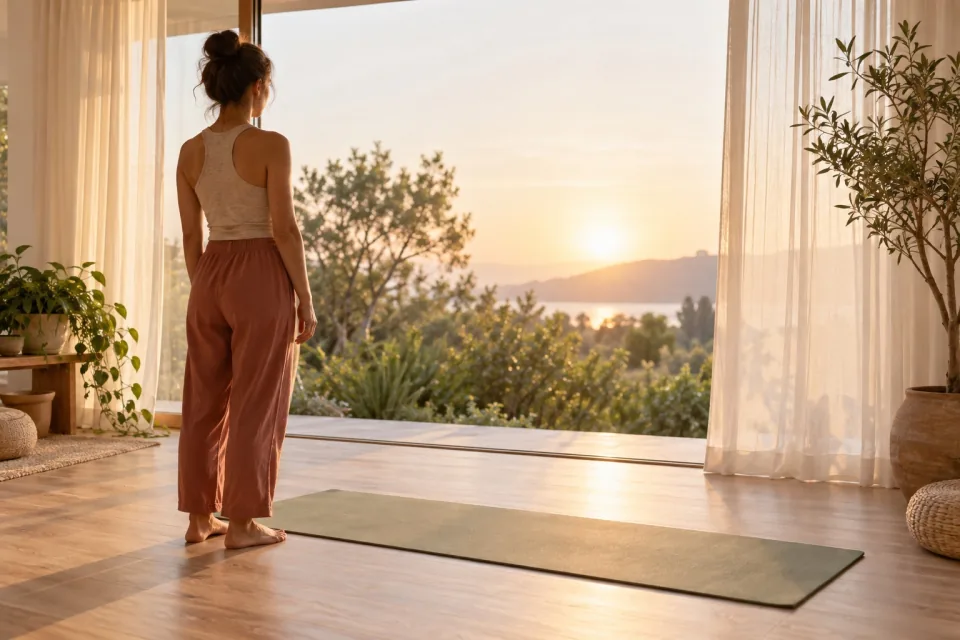
Follow a guided preparation sequence for reaching overhead, folding at the hips and supporting yourself through your hands, then move into the opening of your sun salutation.
Yoga meditation for a noisy home

Follow a seated meditation practice with ordinary household sounds present. Explore breath, sound and touch as attention anchors, then practise returning after wandering thoughts or an interruption.
Head-to-knee pose: align your torso before folding
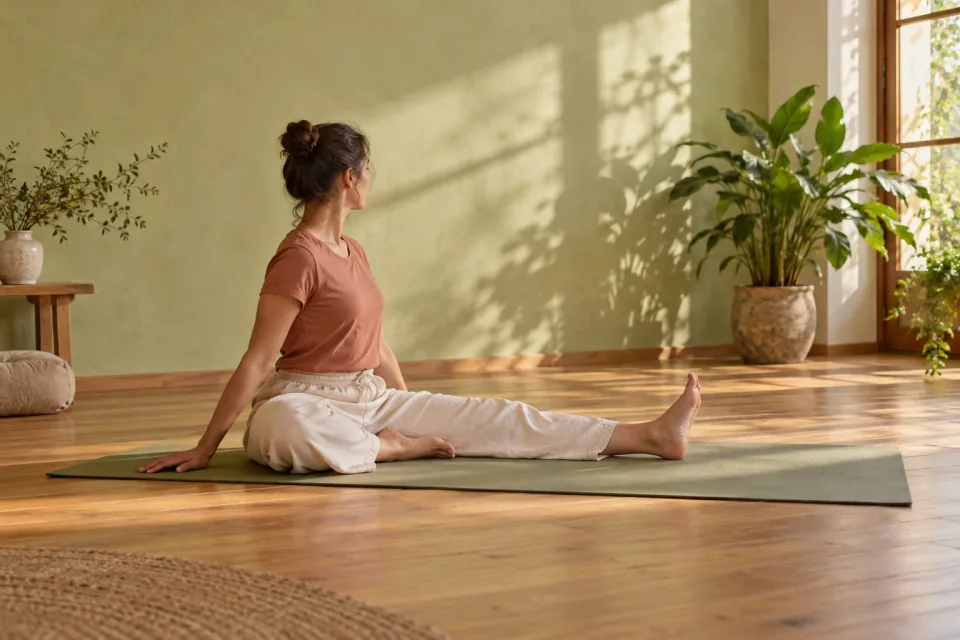
Follow a seated practice that guides your abdomen and ribs toward the extended leg. Choose a reachable hand position, fold from the hips and practise lifting out to reset your alignment.